shape
shape

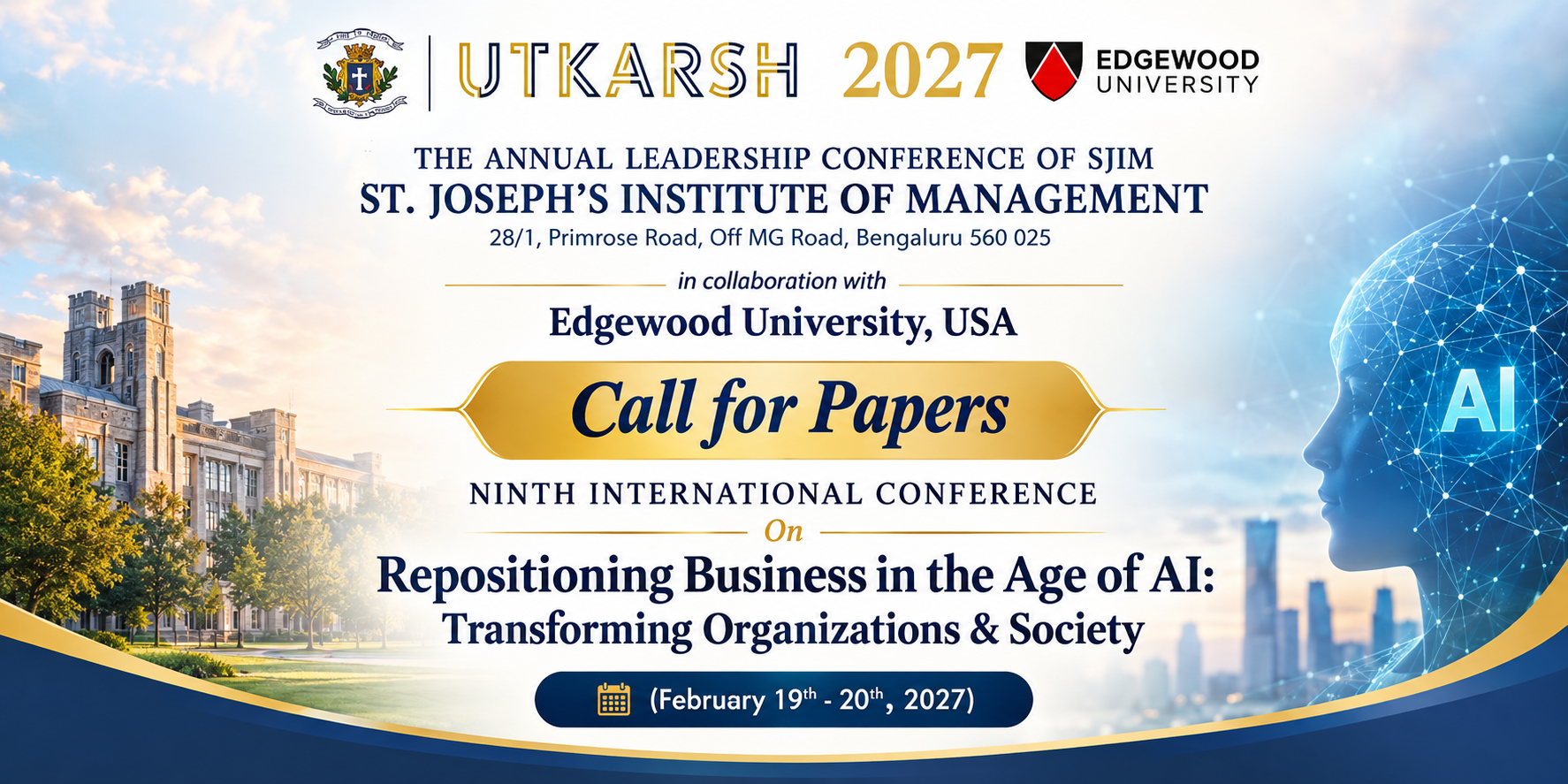
UTKARSH 2027 - Ninth International Conference


About the SJIM

Founded in 1968, SJIM is one of India’s premier B-schools. It is AICTE approved, NBA accredited, and a member of AACSB. Located in the heart of Bengaluru, it has been a beacon of learning, research, and teaching in contemporary management. As the oldest business school in Karnataka, SJIM carries a legacy of over fifty years. Its vision is to create responsible business leaders with integrity, ethics, and concern for society and the environment. SJIM offers ample opportunities to develop individual skills and capabilities. The content and pedagogy are designed to ensure students are industry-ready. Regular interactions with industry leaders, rural exposure, internships, and conferences support students’ overall growth.


About the Edgewood University

Edgewood University, located in Madison, Wisconsin, USA, was founded in 1927 and offers a diverse range of undergraduate and graduate programs across disciplines including business, education, health sciences, nursing, and humanities. Edgewood University is accredited by the Higher Learning Commission (HLC), and its business programs are accredited by the Accreditation Council for Business Schools and Programs (ACBSP). The University embraces innovative and experiential teaching, close faculty-student engagement and learning that connects academic knowledge with real-world challenges. Its research and scholarly activities span multiple disciplines, with faculty engaged in research, applied scholarship, and community-oriented inquiry that contribute to knowledge and address contemporary societal and professional challenges.


About the Conference

What began in 2019 as a platform to bring leadership thinkers, researchers, and industry voices together has evolved into the SJIM Leadership Network- a vibrant ecosystem that explores transformative themes shaping business and society. Over the years, the conference has addressed renewed leadership, sustainability, business agility during turbulent times, and the future of digital transformation.

In its ninth edition, the conference is dedicated to bringing together academics, researchers, industry practitioners, and management students to explore how artificial intelligence and emerging technologies are reshaping the ways businesses compete and organizations operate.. As AI moves beyond experimentation to influence strategic choices, business models, managerial practices, and everyday interactions, organizations are being called upon to rethink established assumptions and reinvent the way they create, manage, and sustain value. The conference provides a multidisciplinary platform to examine these transformations across diverse areas of management. It seeks to foster meaningful dialogue between research and practice, and generate insights that can help organizations navigate technological change while responsibly harnessing the transformative potential of Artificial Intelligence. It also explores the broader implications of these changes for organizations and society.


Suggested Tracks and Sub-Themes*

The conference invites researchers, doctoral students, academicians, industry practitioners and master’s degree students to submit theoretical, empirical research work, case studies and industry notes.. The tracks and sub-themes listed below (but not limited to) would be covered in the conference:

Track 1: Redefining Financial Paradigms through AI

● AI-driven financial decision-making and corporate finance
● FinTech, digital banking and financial inclusion
● AI-enabled risk management and financial resilience
● Algorithmic trading and intelligent investment strategies
● AI, accounting and transparent financial reporting
● Sustainable finance, climate finance and green banking
● Financial innovation and the future of financial services

Track 2: Repositioning People, Work and Organizations

● AI and the changing nature of work
● Human-AI collaboration and augmentation
● Redesigning jobs and organizational structures
● Reskilling, upskilling and workforce adaptability
● Leadership and managerial roles in AI-enabled organizations
● AI-enabled performance management
● Trust, fairness and transparency in AI-mediated workplaces
● Diversity, inclusion and equity in AI-enabled organizations

Track 3: Reinventing Operations for Business Excellence

● AI-Driven Operations and Intelligent Process Transformation
● Smart Manufacturing, Industry 5.0 and HumanAI Collaboration
● Digital Twins and Supply chain Resilience
● Sustainability and Circular Operations
● AI-Enabled Service Operations and Customer Experience
● Responsible AI, Risk and the Future of Operations

Track 4: Marketing in the Era of Intelligent Consumerism

● AI and changing consumer behaviour
● Generative AI and marketing creativity
● AI-enabled personalization and customer experience
● Reinventing branding and brand-consumer relationships
● Consumer trust in AI-mediated markets
● AI, advertising and marketing communication
● AI-enabled market research and consumer insights
● Influencer, creator and AI-generated content ecosystems
● Ethical and responsible AI in marketing

Track 5: Transforming Data into Strategic Intelligence

● Generative AI and the Transformation of Business Analytics
● AI-Driven Predictive and Prescriptive Analytics
● Big Data, Real-Time Analytics and Intelligent Decision-Making
● Responsible, Explainable and Ethical AI Analytics
● People Analytics and AI for Organizational Transformation
● Analytics for Sustainable Business and Societal Impact

Track 6: Fusing AI Innovation with Environmental Stewardship

● Bridging AI Innovation, Organizations and Society
● Responsible AI, inclusive innovation and ethical leadership
● AI-driven organizational transformation and future-ready workplaces
● Balancing technological innovation with societal and environmental impact
● AI, entrepreneurship and emerging business models
● Digital transformation, resilience and organizational agility
● AI, sustainability and the Sustainable Development Goals (SDGs)
● Rural development, social inclusion and community empowerment
● Ethical dilemmas in AI-driven decision-making
● AI, governance, trust and societal resilience
● Life-cycle perspectives on AI technologies and business models

* Each track will feature a Best Paper Award (certificate only), provided there are at least 8 papers presented in person. An Overall Best Paper Award (cash prize of Rs. 5000 and certificate) will also be given provided the eligibility of physical presentation at SJIM is fulfilled.


Who Should Attend?

The conference will provide an opportunity to doctoral students, faculty members, research staff, post graduate students, and industry practitioners to interact with the leaders. Participants will get an opportunity to listen to some of the best minds in the industry and build a professional network. They can present their systematically conducted research work and working papers in front of a panel of experts and receive objective feedback.


Conference Attraction

● Listen thought-provoking sessions from eminent panellists with diverse industry backgrounds.

● Hone your working papers or disseminate the research findings with fellow researchers.

● Publish full-length paper with the Scopus indexed Book series from renowned publishers like Springer, Elsevier and an ISSN journal.

● Networking opportunities with industry leaders and practitioners.


Publication Opportunities

The following book series and journal are being considered to publish high-quality papers submitted to the conference. Selected papers* from the conference will be forwarded by the editors for further review, whose decision will be final and binding for publication.
● Atlantis Press (an in-print of Springer Nature)- Scopus indexed
● Elsevier- Scopus indexed
● Business Review- A peer reviewed journal of SJIM (All UGC guidelines are met |ISSN:0973-9076)
* Master’s student papers co-authored with faculty will be eligible for publication


Authors Guidelines

Preparation of Extended Abstract:
The extended abstract must include the following headings and adhere to the guidelines provided below:
Title, Author(s) Name, Affiliation, Purpose of the Study, Research Design/Methodology/Approach, Findings, Research/Theortical/Practical/Social Implications, Originality/Novelty, Conclusion, Limitations and Future Research Directions, and 3-5 Keywords.

Preparation of Full Research Article:
● Research paper should include in a given order: Title, Author (s) name and Affiliation, Abstract, Keywords, Main Text (Introduction, Review of Literature, Research Methodology, Analysis and Findings, Conclusion, Limitations and Future Research Directions, References) and Acknowledgement (if any).
● Paper title, Author(s) name and Affiliation, Contact Number and E-mail address should be centrally aligned, bold, capital letters, font size - 12, Times New Roman on the first page of the Article
● All photographs, charts and diagrams are to be referred as ‘Figures’ and should be numbered consecutively in the order to which they are referred in the text.
● Reference/Bibliography should be in APA (7th edition) format.
● The word limit for Full paper is 8000-9000 words.
● Line spacing: 1.5 and Margin: 1 inch on all sides, Font size 12, Times New Roman, Research paper should be submitted in Microsoft Word.
● In case of articles which are co-authored, at least one author needs to be registered for the conference to get their paper considered for presentation/publication.
● A copyright declaration should be given by the corresponding author stating that the work is original and does not violate the rule of copyright.
● All full papers submitted will be subject to a blind review process. Comments of the reviewers will be sent directly to the author(s).



Submission Guidelines

Extended Abstract and Full-Paper, completed in all respects, should be submitted in MS Word format on the Microsoft CMT using the given weblink.
CMT Weblink: https://cmt3.research.microsoft.com/Utkarsh2026/Submission/Manage
CMT ACKNOWLEDGMENT: The Microsoft CMT service was used for managing the peer-reviewing process for this conference. This service was provided for free by Microsoft and they bore all expenses, including costs for Azure cloud services as well as for software development and support.


Important Dates

Abstract Submission Deadline November 10, 2026
Notification of abstract acceptance/rejection November 15, 2026
Full Paper Submission Deadline (for those interested in full paper publication) December 30, 2026
Conference Dates February 19-20, 2027


Registration Details
Paper presenters and participants can register for Utkarsh 2027 by remitting the registration fees through weblink.

Category Early bird
(Until 20th November, 2026)
Regular
(6th Jan, 2027-30th Jan, 2027)
Late Registration
(1st Feb, 2027- 18th Feb, 2027)
On-spot
(19th - 20th Feb, 2027)
Student Rs. 500 Rs. 1000 Rs. 1500 Rs. 2000
Research Scholar Rs.1000 Rs. 1500 Rs. 2000 Rs. 2500
Faculty Rs. 1500 Rs. 2500 Rs. 3000 Rs. 3500
Industry Rs. 2500 Rs. 5000 Rs. 5500 Rs. 6000


CONFERENCE ORGANIZING COMMITTEE

Chief Patron : Rev. Dr. Daniel Fernandes SJ
Vice President, BJES
Patron : Rev. Dr. Roshan David Periera SJ
Director, SJIM
Conference Chair : Dr. Rajiv Noronha
Dean, SJIM
Conference Advisor : Dr. Anand Das Gupta
Former Professor, IIPM Bangalore
Conference Convenors : Dr. Deepika Joshi,
Chair, Research Cell
Conference Co-Convenors : Prof. Hanfia Rahman, Assistant Professor
Dr. Poornima S, Assistant Professor
Student Coordinators : Ms. Spatika Copparan (+91 8105006343) & Mr. Abhay S. Bhat (+91 6361875491)